
New Jersey DOC Release Paths
NJDOC is a statewide prison system for sentenced custody. The department’s current institution list does not identify an NJDOC prison inside Hudson County. A person whose state record shows Hudson as the county of commitment may be confined at an institution elsewhere in New Jersey. That field points to the case and sentence origin, not the current facility or release gate.
A state-prison exit may be parole, a statutory supervision release, a maximum-term discharge, or another authorized movement. Parole ends physical prison confinement while State Parole Board conditions continue. A maximum-term discharge may end the custodial sentence, but another case, detainer, or supervision term can still affect the person. The NJDOC history, final discharge paperwork, and SPB record each answer a different part of the release question.
Confirm a New Jersey DOC Release
Use the NJDOC Offender Search first when a state commitment or transfer appears in the timeline. The State Bureau of Identification number, or SBI number, is the strongest public search key when known. Names and aliases can collide, so compare the record’s commitment, sentence, and identity fields before treating it as a match.
- Open the statewide search and accept its terms. Search by SBI number when possible, or use the available name fields.
- Compare aliases, sex, county of commitment, case or commitment order, offense, and sentence details.
- Review current status and facility. A Hudson county-of-commitment entry does not place the person at the county jail.
- Look for Date Out-of-Custody and incarceration history when confirming an already completed NJDOC release.
- Keep Current Max Release Date and Current Parole Eligibility Date separate. Both are calculations, not proof of a completed discharge.
- Request the final release record from NJDOC, then contact SPB if parole or mandatory supervision appears.
The Hudson County released-inmate search covers the earlier county event, court case, and other systems when the state record is only one step in a longer custody sequence. An NJDOC search miss does not disprove a municipal arrest or a county stay that never became a state commitment.
New Jersey DOC Search Fields
NJDOC’s record carries state sentence and custody fields that a county roster cannot supply. Read the labels as the department defines them. A result may include aliases, SBI number, commitment order, county of commitment, offense, sentence date, mandatory minimum, maximum term, current location or status, and prison sentence history.
| Field | Use in a release check |
|---|---|
| SBI number | Distinguishes the state record from name-only matches |
| County of commitment | Shows where the prosecution and sentence arose |
| Current facility or status | Shows the system’s current custody label at lookup time |
| Date In-Custody | Marks the start of the displayed NJDOC custody period |
| Date Out-of-Custody | Supports a completed historical state-custody exit |
| Current Max Release Date | Shows the latest calculated outer release date |
| Current Parole Eligibility Date | Shows the expected point for parole consideration |
| Mandatory minimum | Shows a sentence limit on earlier release, subject to credits and the judgment |
The official NJDOC offender search screen can show these state-specific distinctions.
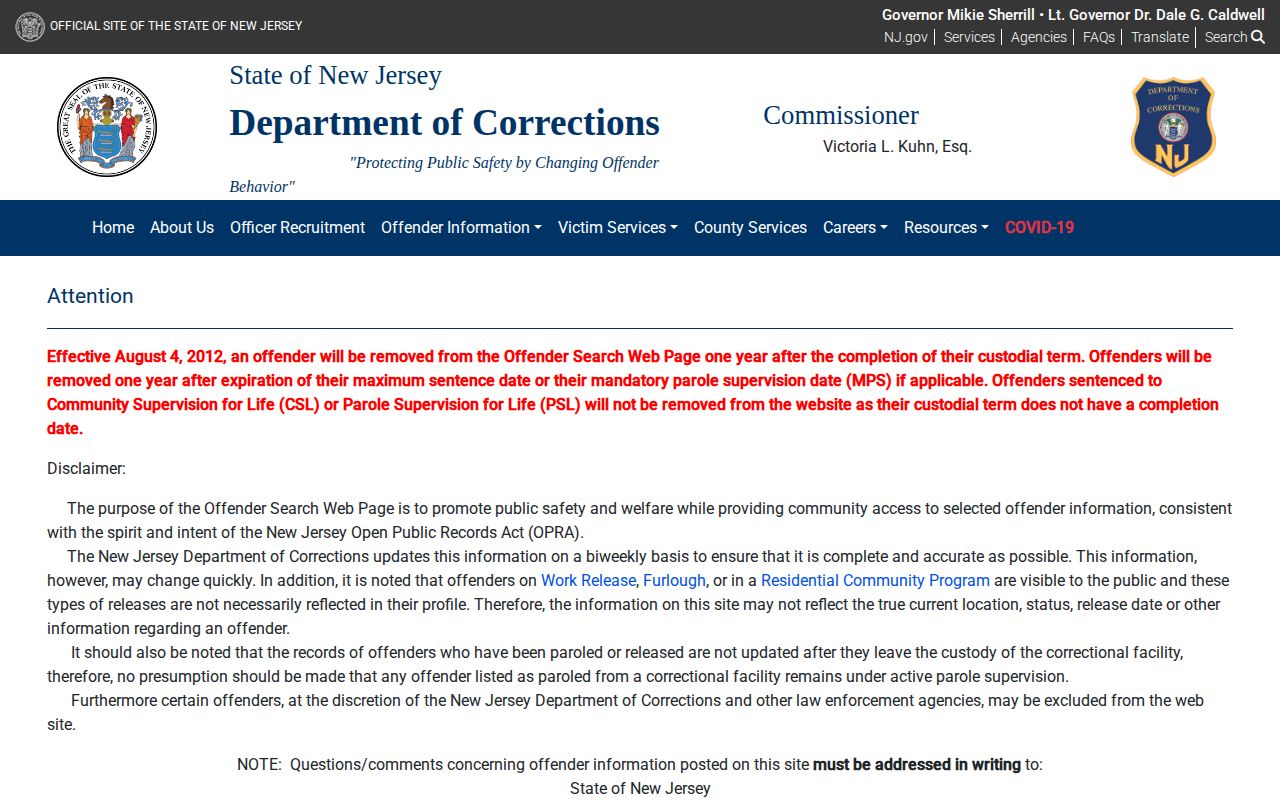
Date Out-of-Custody is more probative of a finished NJDOC release than a future calculation. Preserve the access date because a later search can display a different current status or calculation.
New Jersey DOC Date Differences
Current Max Release Date is NJDOC’s calculated outer date. It reflects days earned off the sentence and days added after negative institutional conduct. Current Parole Eligibility Date is the latest expected eligibility date based on State Parole Board policy and calculation. Eligibility permits parole consideration. It is not a grant, a gate date, or an actual discharge.
- Maximum date
- A sentence calculation that can change with lawful credits and adjustments.
- Parole eligibility
- The point when the Board may consider release, subject to a mandatory minimum and other rules.
- Parole grant
- A Board decision that sets a future effective date and can still face rescission.
- Date Out-of-Custody
- The historical NJDOC field tied to an actual completed custody exit.
- Final discharge
- The end of the relevant custody or supervision authority shown by the responsible agency record.
A mandatory minimum, new sentence, detainer, Board denial, rescission, credit recalculation, or disciplinary adjustment can keep an expected date from becoming the actual release date. The filed judgment controls the sentence. NJDOC controls its calculation, and SPB controls parole decisions.
Why NJDOC Release Dates Change
NJDOC’s Offender Search Engine Help gives a rare, precise warning: Current Max Release Date may differ at the end of each month. Two screenshots with different maximum dates can both reflect the official calculation at the time viewed. Record the access date beside each result instead of treating the later number as proof that the earlier capture was false.
Credits explain part of the movement. N.J.S.A. 30:4-140 provides commutation credits for eligible state terms, and N.J.S.A. 30:4-92 addresses work credits. Credits may be earned, forfeited, restored, or limited by the sentence. Court-awarded jail credit also follows the judgment. A calculation cannot erase a mandatory minimum where the governing law bars an earlier release.
The No Early Release Act, N.J.S.A. 2C:43-7.2, sets an 85-percent parole-ineligibility minimum for its enumerated first- and second-degree offenses. It does not apply to every New Jersey prisoner. For cases outside a controlling bar, N.J.S.A. 30:4-123.51 and SPB guidance describe ordinary eligibility at about one-third of the sentence. Neither rule supplies an actual release timestamp.
A practical review starts with the filed judgment and its court-awarded confinement credit. Next, identify any mandatory minimum. NJDOC then applies eligible state commutation and work credits to its calculation, while SPB determines parole eligibility and later action. County-jail credits under N.J.S.A. 30:8-28 and 30:8-28.1 belong to a different framework and should not be copied into a state calculation. Consecutive terms, overlapping terms, and gap-time questions require the actual judgment and agency calculation rather than simple subtraction from the headline sentence.
Note: Save the lookup date with each calculated field, then confirm the completed release through NJDOC history or agency records.
New Jersey DOC Release Records
The public search is a lookup tool, not the full discharge file. Use NJDOC’s own OPRA channel for an existing final release or sentence record. Ask for the actual release date, release mechanism, sending institution, final sentence calculation, and final maximum or expiration date. A public identification image may be requested if it is maintained and disclosable, but its existence on every released result should not be assumed.
New Jersey Department of Corrections
Statewide offender search and records system
Offender information and records channels
Use the agency’s current OPRA instructions for formal records
Be precise. Supply the full name, aliases, SBI number, commitment order, and approximate custody dates when known. Ask for a public record rather than asking staff to calculate a new date or explain an entire case. Medical, victim, security, presentence, and other protected information may be redacted or withheld. Request the exemption basis for any denied portion.
NJDOC Release and Parole
A person can leave prison and remain under legal supervision. The New Jersey State Parole Board decides and supervises parole and certain mandatory-release supervision. A parole grant sets a future effective date, subject to conditions and possible pre-release rescission. Once release occurs, SPB rather than NJDOC handles the public supervision inquiry.
SPB’s offender-information instructions direct users to NJDOC first, then provide a public-information email for a person who has been paroled. Formal Board records use the SPB OPRA form. Ask for the final decision, grant or denial date, future eligibility term, scheduled parole date, and any later public rescission, revocation, or discharge record that fits the question.
District Office No. 4 is in Jersey City and provides the local Hudson supervision layer. It is not a prison, probation office, or open public roster desk. The Hudson County post-release supervision resource distinguishes parole from court-run probation and explains the public verification route.
Hudson County NJDOC Commitments
A Hudson County prosecution can lead from the county correctional center to an NJDOC reception and prison assignment elsewhere in the state. The county release event may then say transfer to DOC. That entry closes the county custody episode but does not mean community release. NJDOC’s Date In-Custody and incarceration history can document the next phase after intake processing.
At the other end, an NJDOC Date Out-of-Custody does not prove that every legal obligation ended. Check SPB for parole or statutory supervision, the court for the judgment, and another authority if a detainer appears. VINE can provide a participating-agency event notice, but its “released” wording still needs confirmation from the source agency and destination record.
No NJDOC prison was identified inside Hudson County on the department’s current institution list. That fact prevents a common location error. “Hudson” on a state result most often describes the county of commitment, while the current facility field identifies where NJDOC held the person. Keep both fields in any written chronology.