
Hudson Projected and Actual Release
New Jersey uses several dates that answer different questions. NJDOC’s exact public label is Current Max Release Date. It is the most recent calculated outer date after eligible days earned off the sentence and days added for negative institutional conduct. Current Parole Eligibility Date estimates when State Parole Board consideration may begin under its calculation rules. Eligibility is not approval. A Board grant can set another future effective date. None of those entries is the same as the actual time a person leaves custody.
For a completed state release, look for Date Out-of-Custody and the incarceration history, then request final release or discharge information if the public result is unclear. For a Hudson County jail release, ask for the county admission-and-release event. It can show the physical processing date and time, release code, authority, and destination if those fields are maintained and disclosable. The court order explains why release was legally permitted but may not show when jail staff completed it.
Find a Hudson Release Date
Choose the search route by custody level. A Hudson arrest that never reached the county jail belongs first to the arresting municipal police department and the related court. An Adult Correctional Center record belongs to Hudson County’s Department of Corrections and Rehabilitation. A state-prison sentence belongs to NJDOC. The Hudson County release search and records hub gives the broader custody-confirmation chain when the correct agency is not yet clear.
- Identify the case, booking, SBI number, and last known custodial agency where available.
- For state custody, open the NJDOC Offender Search, accept its terms, and search by SBI number or the offered name fields.
- Read Current Max Release Date and Current Parole Eligibility Date as separate calculations. Review the sentence history and mandatory minimum.
- For county custody, call the Hudson Record Room at (201) 395-5600, extensions 5082 or 5083, and request the existing calculation or release record when needed.
- Check the filed court judgment for the sentence, court-awarded jail credit, consecutive or overlapping terms, and any later order.
- Confirm an actual release with Date Out-of-Custody, the county release event, or agency-issued discharge paperwork.
Use at least two reliable identity points. Name plus SBI, booking number, case number, or birth data is safer than name alone. Record the lookup date because calculated values can change.
Hudson County Sentence Dates
Hudson County publishes no verified public jail sentence calculator. A person held before trial has no earned-time date to estimate. New Jersey’s risk-based pretrial process turns on a judicial release or detention decision, and a prosecutor may seek detention. The absence of a monetary bond does not produce a scheduled release day. Another warrant, detainer, or case can also keep the person confined after one court authorizes release.
A sentenced county inmate uses a different calculation. The filed judgment can award credit for qualifying time already spent in custody. New Jersey county-jail credit statutes include N.J.S.A. 30:8-28 and 30:8-28.1, but only the commitment and release staff can apply the governing judgment and current record to one person. Request the calculation sheet or release record. Subtracting days from a headline sentence can miss jail credit, the actual start date, overlapping terms, forfeiture, restoration, or another legal hold.
When the court and jail dates differ, the records may describe different stages. The judgment supplies legal terms. The jail calculation applies them operationally. The release event shows when that custody episode ended. Preserve all three labels instead of forcing them into one date.
Note: A Hudson County jail release can be a transfer to NJDOC, federal custody, immigration custody, or another jail rather than community release.
Read Hudson NJDOC Date Fields
An NJDOC result contains more than a date. Search by SBI number when known, then compare the name used on the commitment, aliases, county of commitment, case or commitment number, sentence date, offense, mandatory minimum, maximum term, current facility or status, and sentence history. “Hudson” as the county of commitment means the case arose there. It does not mean the person is housed at Hudson County’s jail.
| Field | What it answers | Key limit |
|---|---|---|
| Date In-Custody | When the NJDOC custody period began | May follow an earlier county episode |
| Date Out-of-Custody | When a past NJDOC custody period ended | Check later supervision and custody |
| Current Max Release Date | Current calculated outer release date | May move at month-end |
| Current Parole Eligibility Date | Expected Board eligibility point | Not a grant or actual release |
| Mandatory minimum | Period that must be satisfied before release eligibility | Read with court credit and governing law |
| Incarceration history | Prior NJDOC custody episodes shown | Does not replace a Hudson jail release record |
A missing NJDOC result does not disprove a Hudson arrest or county stay that never became a state commitment. If the county release record says “transfer to DOC,” allow time for intake processing and search again with the SBI number. If a released historical result appears, keep the access date and request agency records when the final mechanism or destination is not clear.
Why Hudson Release Dates Shift
The NJDOC Offender Search Engine Help carries a distinctive warning: Current Max Release Date may differ at the end of each month. That means two screenshots captured on different dates can both have accurately reflected the public calculation at the time. Keep the access date with each image or note. Never silently replace an older value and imply the earlier source was false.
The official help screen below defines the state date labels used in a Hudson County release date lookup.
Review NJDOC’s calculated-date definitions and search help.
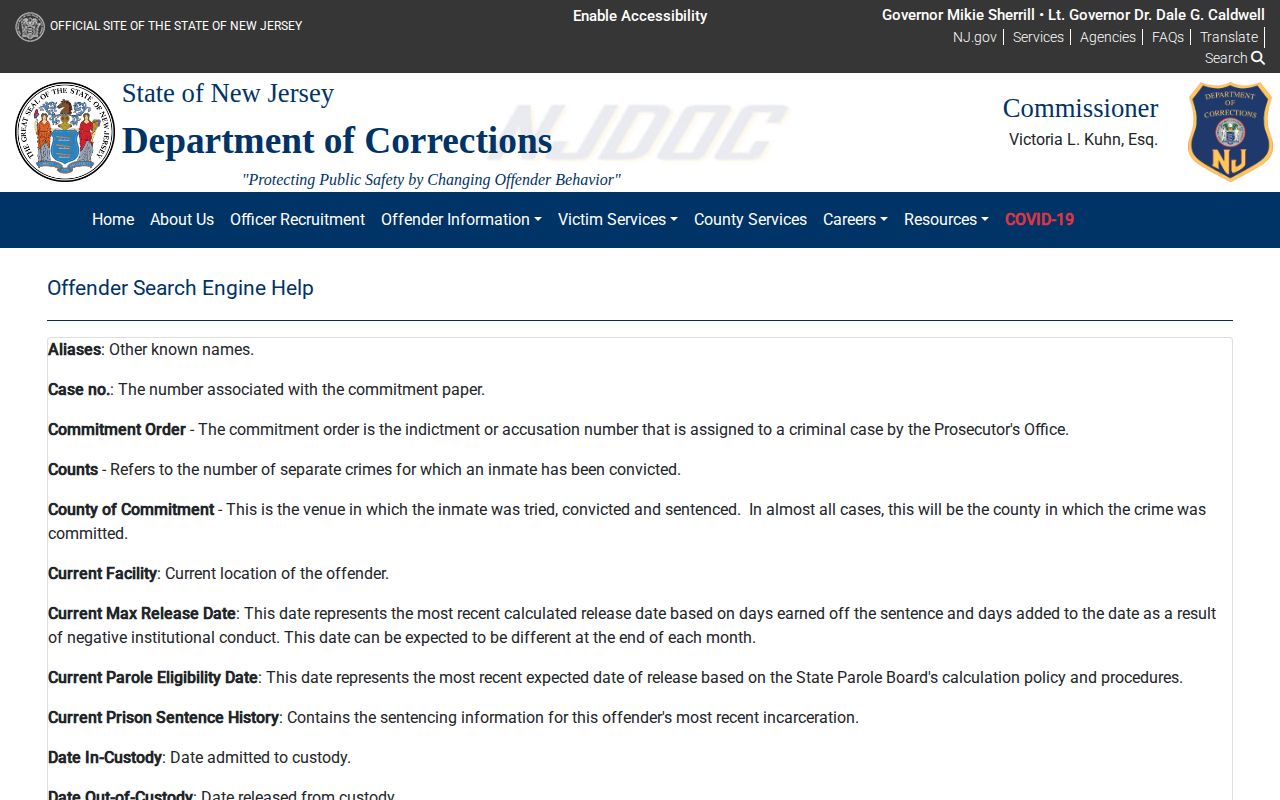
The distinction shown there is central: the maximum calculation can move, while a parole eligibility calculation serves a separate Board process.
Monthly recalculation is not the only cause. A later judgment, corrected credit, disciplinary adjustment, mandatory minimum, new sentence, detainer, parole decision, or rescission can also alter the expected path. Confirmation must come from the agency that controls the date.
Hudson Release Credits and NERA
State sentence credits operate within the judgment. N.J.S.A. 30:4-140 provides commutation credits for eligible state terms based on continuous orderly behavior. N.J.S.A. 30:4-92 permits work credits and includes rules for certain assignments. Credits may be forfeited, restored, or limited. They do not override a mandatory minimum where the law bars earlier parole or release. The New Jersey Legislature statute search supplies the official statutory text.
New Jersey’s No Early Release Act, N.J.S.A. 2C:43-7.2, requires an 85 percent parole-ineligibility minimum for enumerated first- and second-degree offenses. It is not a rule that applies to every New Jersey sentence. Covered cases also carry a period of parole supervision. General parole eligibility under N.J.S.A. 30:4-123.51 is ordinarily around one-third of the sentence unless a parole-ineligibility period applies, but eligibility merely opens the Board process.
Court-awarded presentence credit must be read from the judgment and sentence calculation. “Gap time,” consecutive terms, and overlapping sentences can involve legal questions that should not be guessed from a web result. Final authority rests with the court and the responsible sentence-calculation unit.
A safe calculation example uses no real person. Suppose a judgment states a prison term, a mandatory minimum, and court-awarded confinement credit. Start with the filed judgment, determine whether NERA or another parole bar controls, and let NJDOC apply eligible commutation, work, and minimum credits to its current maximum calculation. Then compare Current Max Release Date with Current Parole Eligibility Date. Even if one date comes first, it remains only the date described by that field. A Board grant, detainer, discipline change, corrected judgment, or new sentence can alter what happens next.
The exercise shows why a simple calendar subtraction fails. It also keeps county and state custody apart. Time credited by the court may affect the state sentence, but Hudson County’s physical transfer event and NJDOC’s intake are separate records. The actual release does not exist until the responsible agency completes and records it.
Hudson Release Date Changes
A projected date changes when a new fact alters the sentence or the way it is served. The table separates common causes from the record that can confirm each one.
| Factor | Possible effect | Best record |
|---|---|---|
| Eligible credits | Can move the current maximum calculation earlier | NJDOC sentence calculation |
| Disciplinary adjustment | Can add days or affect earned credit | Updated NJDOC calculation |
| Mandatory minimum | Bars release or parole before the controlling period | Judgment and sentence history |
| Detainer or hold | Can cause transfer or continued custody after one term | Agency release destination and receiving record |
| New or corrected court order | Can alter credit, term, or sentence structure | Filed court order |
| Parole grant, denial, or rescission | Changes the Board path without changing every other date | Final State Parole Board decision |
A parole grant sets a future effective date and can still face rescission if new information or institutional conduct arises before release. A denial sets a Future Eligibility Term for another review. Neither should be reported as the gate timestamp.
Confirm Hudson Actual Release Dates
For a state prisoner, retain the NJDOC historical result when it shows Date Out-of-Custody and incarceration history. If more proof is needed, use NJDOC offender-information and records channels to ask for the actual release date, release mechanism, sending institution, final maximum date, and supervision status that are publicly disclosable. Final discharge paperwork described in state reentry material is stronger than a forecast.
For the Hudson County Adult Correctional Center, request the existing booking/admission and release/discharge record for the same episode. Ask for release date and time, release code with its definition, authorizing authority, and transfer destination. Pair that response with the court judgment. A court order can explain authority but may not establish the precise physical discharge time.
New Jersey VINE can supply a custody-change alert from a participating agency. Registering through the Hudson County VINE inmate check can help track a pending event, but the source agency must confirm whether “released” meant community release or transfer. Notification delivery time can also differ from the event time.
Use this final chronology: projected calculation, parole or court decision, actual custody event, destination, and any later supervision. It answers “when will they be released” without turning an estimate into a fact.