
Hudson Parole and Probation
Parole follows release from a prison sentence and is decided and supervised by the New Jersey State Parole Board. The person has left physical prison custody but remains subject to Board conditions until discharge or another lawful end point. Probation is a court sentence or court-supervision status administered through New Jersey’s Judiciary. It may follow a county jail term, accompany a noncustodial sentence, or continue after the custodial part ends. A Hudson County pretrial release is different again. Conditions imposed while a criminal charge is pending do not automatically make the person a parolee or probationer.
The filed judgment is the best starting point for probation. For parole, the NJDOC custody history and the Board’s information channel work together. An old jail entry cannot settle the question. Release from the Hudson County Adult Correctional Center records the end of that county custody episode, while supervision is a later legal status maintained by another agency. The full Hudson County released-inmate search and record path explains how to confirm that earlier jail exit before tracing what followed.
| Feature | Parole | Probation |
|---|---|---|
| Authority | New Jersey State Parole Board | New Jersey court and Judiciary |
| Typical starting point | Release from a state prison term | A sentence or court order |
| Public verification | SPB information request or SPB OPRA record | Filed judgment and Hudson Vicinage record |
| Local office | SPB District Office No. 4 in Jersey City | Hudson Vicinage division serving the case |
| End record | Board discharge or final supervision record | Court record showing completion or discharge |
Verify Hudson Post-Release Supervision
Begin with identity and case facts. A common name is not enough. An SBI number, case number, date tied to the custody event, or another agency identifier helps distinguish two people. NJDOC’s public search can show a state commitment and a Date Out-of-Custody, but the State Parole Board’s offender-information instructions explain that parole information uses a separate request route. There is no verified public statewide roster of all parolees or absconders.
- Confirm whether the person’s last custody was Hudson County jail, NJDOC, federal custody, or another system.
- For a possible state parole case, check the NJDOC history and note the SBI number, release date, and county of commitment.
- Send a focused inquiry to SPB-Public-Info-Office@spb.nj.gov, or use the SPB OPRA form for an existing Board record.
- For probation, search the criminal judgment and contact the division identified by the Hudson Vicinage.
- Compare the agency response with the court judgment. Record the status date because supervision can later end, change, or be revoked.
The official SPB information page is visible in the image below. It separates NJDOC offender-search data from the Board’s own public-information process.
View the State Parole Board offender-information instructions.
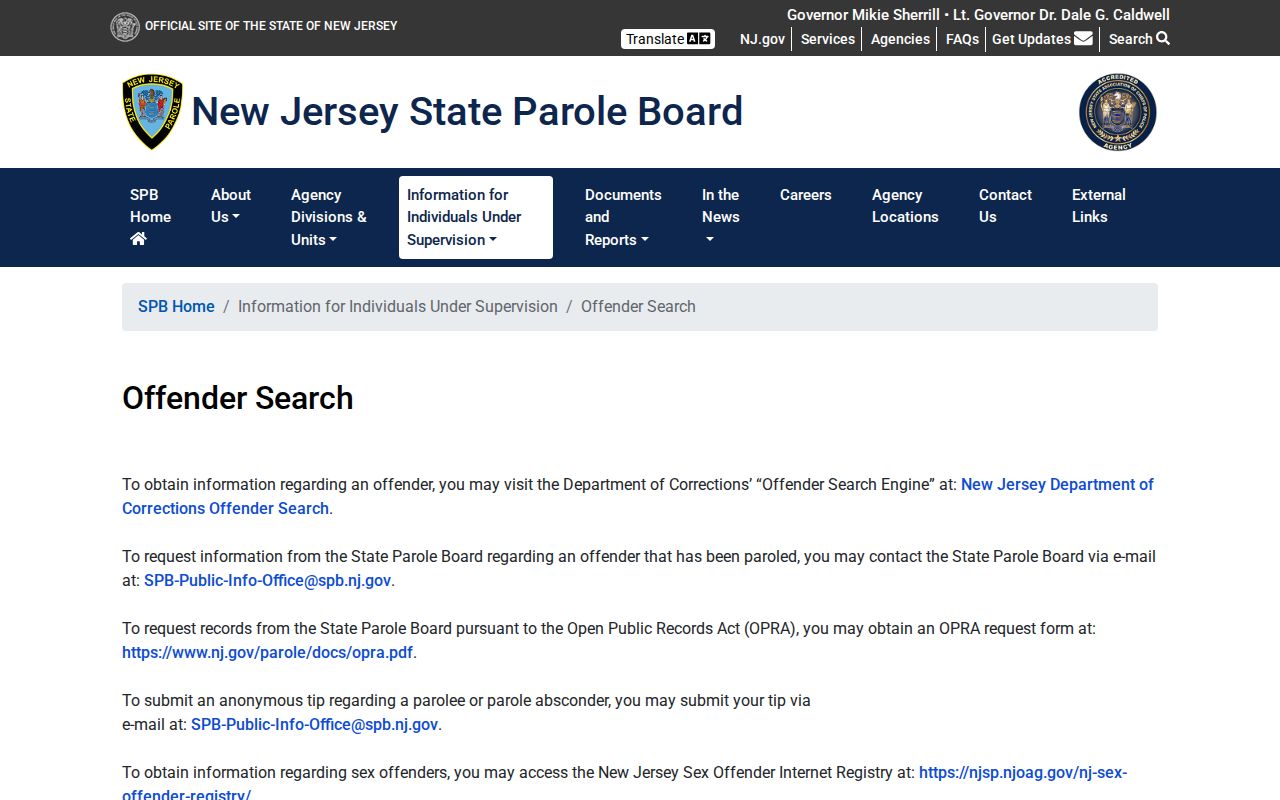
The page supports a records-based inquiry; it is not a live map of reporting locations or a searchable list of every supervised person.
Important: A release date proves that one custody episode ended. It does not prove that parole, probation, or another court condition also ended.
Hudson Parole District Office
Hudson County has a specific local parole presence. SPB District Office No. 4 is in Jersey City. The office supervises parole matters; it is not a jail, a probation office, or a public walk-in roster. A person under supervision should follow instructions from the assigned officer. A member of the public seeking a releasable status record should use the Board’s central public-information or OPRA channel rather than ask for a person’s private reporting routine.
438 Summit Avenue, 6th Floor
Jersey City, NJ 07306
Public records: SPB public-information email or SPB OPRA form
Probation uses a separate local path. Hudson County Superior Court is at 595 Newark Avenue in Jersey City. Its vicinage page carries the current Criminal Division and Probation Services routing. PROMIS/Gavel or the criminal-judgment search may reveal the sentence, but a filed judgment is stronger than a short online label. Court staff may also limit information that is sealed, expunged, or otherwise not public.
Hudson Supervision Terms Defined
Short record labels can hide major legal differences. These definitions keep a Hudson County post-release supervision search tied to the correct event. They do not replace the wording in the judgment or Board decision.
- Parole
- Community supervision after release from a prison term under State Parole Board authority.
- Probation
- A court-imposed status administered through the Judiciary, not a synonym for parole.
- Discharge
- The formal end of the agency’s custody or supervision authority, as shown by its record.
- Absconder
- A supervision status alleging that a person stopped complying or cannot be located. It is not a new conviction.
- Revocation
- A formal process that can end parole status and return a person to custody after a violation finding.
A warrant is also an enforcement document, not proof of guilt on a new charge. Verify it with the issuing authority and court. New Jersey VINE may report a later custody event from a participating agency, but VINE is an alert tool rather than the official supervision record.
Hudson Registry and Supervision Records
The New Jersey Sex Offender Internet Registry is another distinct system. It displays certain people in the community when state notification law calls for internet publication. A match does not supply the Hudson County jail release time, and the registry does not include every person convicted of a sex offense, every person released from prison, or every parolee. Its own warning and displayed fields control what can be said about a result.
Registry status should never be used as a substitute for a parole or probation record. Start from the offense and notification law only when the registry is relevant, then verify supervision through SPB or the court. Likewise, an absent registry result does not prove that parole ended or that no qualifying history exists. These databases answer different questions and can change on different schedules.
VINE is separate too. It reports custody events fed by participating agencies and can send notifications. A Hudson County VINE result may identify county custody, while another result may identify NJDOC. The agency label matters. Neither a VINE alert nor a registry entry contains the final Board discharge or probation-completion order needed to verify that supervision ended.
Hudson Parole Violation Records
Conditions vary by case, so public copy should stay at a high level. A condition may address reporting, travel, treatment, contact, or compliance with law, but the governing order controls. When serious or persistent parole violations are alleged, SPB can use probable-cause and revocation proceedings. The Board’s hearing explanation also describes rescission before release and revocation after release. These stages should not be collapsed into one label.
Revocation can create a new custody chain. A person may first appear in a county jail and then move to NJDOC’s Central Reception and Assignment Facility. A name disappearing from a Hudson jail record may therefore mean transfer, not release to the community. Check the county event, then NJDOC, then the Board decision. If the person is continued on parole, supervision remains in force, perhaps with added conditions. If parole is revoked, physical custody can resume.
For probation, the court owns the enforcement record. A violation filing or warrant is an allegation until resolved. Search the Hudson case and obtain the resulting order. Do not infer the outcome from a custody alert alone.
Board outcome terms also need precision. “Granted” means release was approved for a future effective date, subject to conditions and possible rescission. “Denied” means no release at that hearing and a Future Eligibility Term is set. A deferred or adjourned matter awaits more information or process. “Rescinded” withdraws a grant before release, while “revoked” follows a post-release violation process. A person continued on parole remains supervised, perhaps under added conditions.
Note: Public Board meeting dates are agency business calendars, not individualized Hudson County parole-hearing schedules or person-by-person decision lists.
Hudson Release and Reentry History
Hudson County has a documented reentry model, but the source must be dated. A 2010 New Jersey Attorney General announcement described expanded county work involving community case managers, discharge planning, identification and transportation help, medication continuity, and referrals. It shows how Hudson’s local model developed. It does not promise that every service, benefit, or contact from that announcement remains available in the same form today.
Current navigation should begin with the NJDOC Office of Programming and Supportive Services and its reentry material when a state-prison release is involved. County services and state services serve different populations. Eligibility also matters. A program description is not proof that a named person enrolled, received a bus pass, obtained identification, or completed supervision.
Reentry support and legal supervision should remain separate in a record search. Case management may help a person stabilize after release, while SPB or the court maintains the binding conditions. One does not verify the other.
Hudson Supervision Discharge Records
Supervision ends through a formal agency or court event. For parole, request the public Board status and any releasable discharge or final decision. For probation, use the filed Hudson County judgment and later order showing completion or discharge. Payment questions, completion status, and modifications remain court matters. They cannot be inferred from an old county release date or an expired online result.
Dates must be labeled with care. A prison Date Out-of-Custody marks the end of physical NJDOC custody. A parole eligibility date only marks when Board consideration may occur. A parole grant sets a future effective date and can still face rescission. The final supervision discharge date is another event. Keeping those dates apart prevents a released person from being described as unsupervised too soon.
When records conflict, build a chronology: judgment, custody release, Board action, supervision event, and discharge. Use identifiers from the same case. That sequence gives a much firmer answer than any single name search.